 Attics & roof decks
 Exterior walls
 Crawl spaces & rim joists
 Metal buildings
 Pole barns, shops & ag
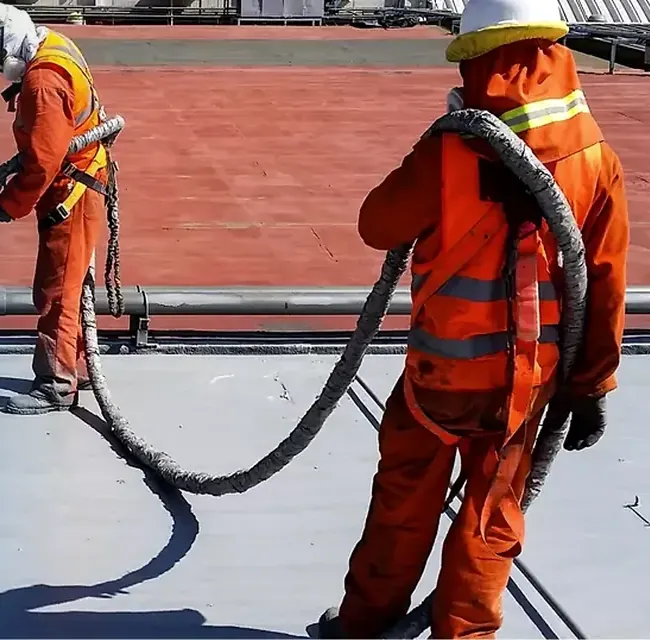 SPF roofing
 Basement walls
 Concrete lifting
SPF Roofing: How Spray Foam Roof Systems Work on Commercial Buildings
A spray polyurethane foam roof is insulation and roofing in one seamless layer, sealed with an elastomeric coating and renewed by recoating. How it is installed, where it fits and what to watch for.
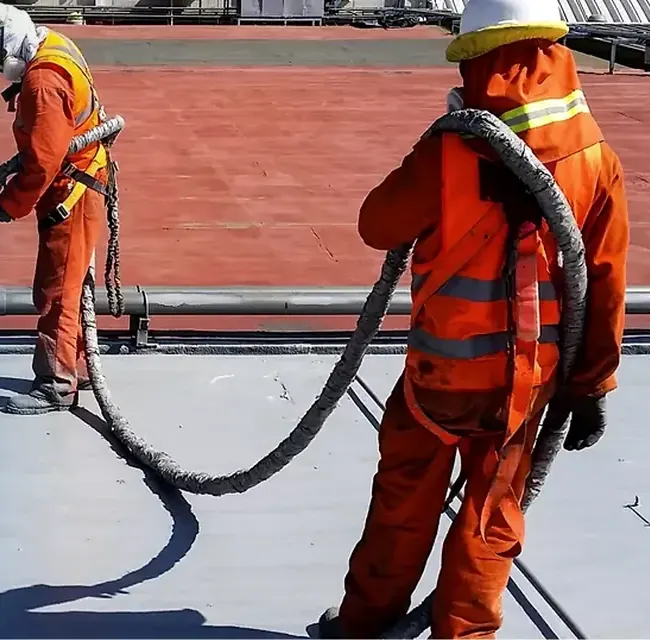
Key takeaways
- An SPF roof is high-density closed-cell foam sprayed onto the roof deck or an existing roof, then sealed with an elastomeric coating.
- It is seamless, adds insulation, can be built up to fix low spots and ponding, and is maintained by recoating instead of tearing off.
- The existing roof gets a moisture survey first; wet insulation comes out before foam goes down.
- Wind, temperature and moisture limits matter — SPF is installed by trained crews on the right days.
Most commercial roofs are a stack of separate parts: a deck, a layer of rigid insulation, a cover board, a membrane, and a lot of seams, fasteners and flashing details holding it all together. Each seam is a place a leak can start.
A spray polyurethane foam (SPF) roof replaces most of that stack with one continuous layer. Here is how it works and where it makes sense.
What an SPF roof is
An SPF roof has two parts:
- The foam. A high-density closed-cell polyurethane — typically around 2.5 to 3 lb per cubic foot, denser than wall foam — sprayed directly onto the roof deck or over a prepared existing roof. It expands, bonds and cures into a rigid, seamless layer.
- The coating. Foam does not hold up to sunlight on its own, so it is sealed with an elastomeric coating: silicone, acrylic, polyurethane or polyurea. The coating handles UV and weather; the foam handles insulation, waterproofing and drainage shape.
ArmorThane’s ArmorFoam Roof 200, for example, is a two-component, closed-cell, Class A fire-rated exterior roofing foam with nominal core densities from 2.5 to 3.0 pcf.
Why building owners choose it
- Seamless. No laps, no fastener rows, fewer places for water to get in. Penetrations and parapets are foamed in continuously.
- Insulation built in. Every inch of foam adds R-value, which cuts cooling loads under a hot roof.
- Fixes drainage. Foam can be sprayed thicker in low areas and tapered toward drains, eliminating ponding.
- Light. Foam adds very little weight compared to adding more conventional layers.
- Renewable. When the coating wears, it is cleaned and recoated. Well-maintained SPF roofs can stay in service for decades.
How an SPF roof goes on
Where SPF fits — and where it does not
SPF shines on low-slope commercial, industrial and agricultural roofs, including over corrugated metal where filling the flutes and sealing the fasteners solves chronic leaks. It is also popular on roofs with lots of penetrations and odd shapes, where membranes get complicated.
It is a poorer fit when the existing roof is saturated and the owner will not pay to remove the wet material, or when the site cannot be protected from overspray on windy days. It also needs a crew that does it regularly: weather, foam temperature and surface condition all affect quality.
Overspray is real
Spray foam and coatings drift in the wind. Good crews check wind speed constantly, use screens, and protect cars, HVAC units and neighboring buildings. Ask how they will handle it on your site.
Maintenance
An SPF roof wants a little attention: an inspection once or twice a year and after major storms, prompt repair of any mechanical damage (a dropped tool, hail bruising), and a recoat when the coating thins. Small foam repairs are fast and inexpensive. It is the opposite of a “set and forget” roof — and that is why it lasts.
Questions to ask a roofing contractor
- What foam density and thickness, and which coating at what dry film thickness?
- How will you survey the existing roof for moisture, and what happens to wet areas?
- Can the design correct ponding and improve drainage?
- What warranty applies, and what maintenance does it require?
- How will you control overspray on this site?
Frequently asked questions
Can spray foam go over my existing roof?
Often, yes. Codes limit re-covering over wet roofs or roofs that already have multiple layers, so the existing roof gets a moisture survey and any wet material is removed. Where it qualifies, SPF can be applied over built-up, modified bitumen, single-ply and metal roofs after proper preparation.
How often does an SPF roof need to be recoated?
It depends on the coating type and thickness, the climate and how much traffic the roof gets. Many systems are designed for a recoat cycle measured in years to a couple of decades, with periodic inspections in between.
Can you walk on a spray foam roof?
Yes. Roofing foam is formulated with higher density and compressive strength than wall foam. For areas with regular foot traffic, crews add walk pads or embed granules in the coating.
Next step
Get the right foam for your building.
Share a few details and the ArmorThane team will follow up with recommendations, pricing guidance and an applicator.
(417) 831-5090Keep reading
Related guides
How to Start a Spray Foam Insulation Business
Equipment, training, licensing, insurance, pricing and finding the first customers — a practical roadmap for launching a spray foam insulation company, and…
Polyurethane Foam Concrete Lifting: How Polyjacking Works
Sunken driveways, walks and floor slabs can often be raised instead of replaced. How expanding polyurethane lifts concrete, how it compares to…
Spray Foam on Basement Walls: Insulating Concrete Without Trapping Moisture
Basement walls lose heat and invite condensation. Why closed-cell foam bonded to the concrete beats a stud wall full of fiberglass, what…