 Attics & roof decks
 Exterior walls
 Crawl spaces & rim joists
 Metal buildings
 Pole barns, shops & ag
 SPF roofing
 Basement walls
 Concrete lifting
Spray Foam for Pole Barns, Shops and Ag Buildings
Post-frame buildings fight condensation, dust, pests and washdown. How closed-cell foam and protective coatings handle each one — with starting thicknesses by building type.
Key takeaways
- Post-frame buildings are thin steel over girts and purlins — the classic recipe for condensation, drafts and temperature swings.
- Closed-cell foam sprayed to the steel stops dripping, seals laps and stiffens the skin.
- Livestock and washdown buildings usually need a protective coating over the foam to stand up to moisture, cleaning and pests.
- Pick thickness by use: storage needs condensation control; a heated shop needs real R-value.
Post-frame buildings are hard to beat for value. A few posts, some girts and purlins, steel sheets screwed on top — and you have a big, clear-span space for equipment, livestock, a workshop or a hobby. What you also have is a thin metal skin with very little between it and the weather.
That is why so many pole barns and shops drip in the winter, bake in the summer and gather dust everywhere. Closed-cell spray foam fixes most of that in one pass. Here is how it applies to the different kinds of buildings people put up.
The problems post-frame buildings have
- Condensation. Warm, humid inside air meets cold steel and water forms — dripping on equipment, rusting fasteners, soaking stored hay or grain.
- Air leaks. Panel laps, eaves, base trim and the gaps around doors let wind, dust and snow in.
- Temperature swings. Uninsulated steel is freezing in winter and an oven in summer.
- Pests. Loose blanket insulation is a nesting paradise for birds and mice.
- Moisture and ammonia. In livestock buildings, the air is humid and corrosive, and the surfaces get washed down.
Why closed-cell foam is the default
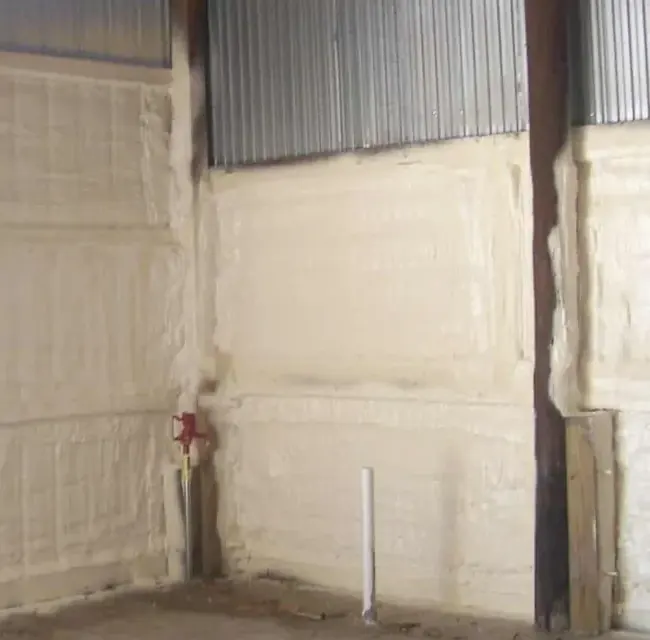
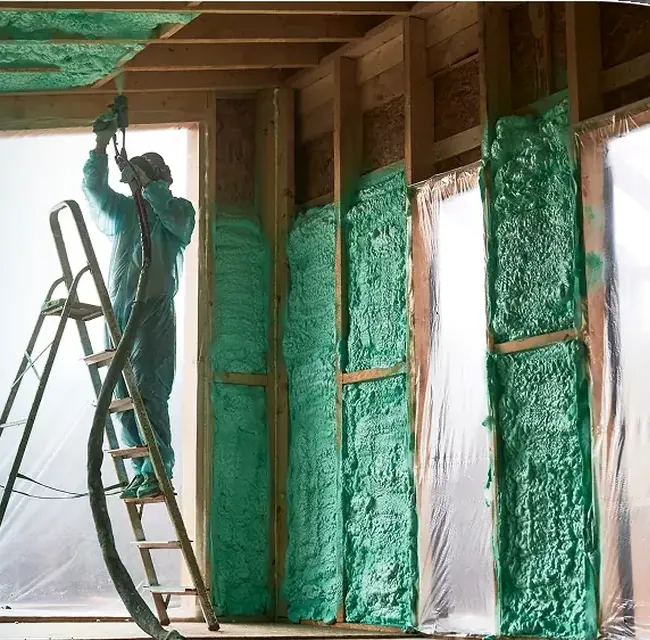
Two-pound closed-cell foam goes straight onto the inside of the steel, between and over the girts and purlins. It bonds to the metal, so there is no gap for humid air to reach and condense. It seals the laps and fastener holes. And as a rigid foam, it adds stiffness to the skin and quiets rain and wind noise.
Open-cell foam is a poor fit here. It is vapor-open, so moist air can pass through it to the cold steel behind — exactly what you are trying to stop.
Starting thicknesses by building type
These are common starting points, not code minimums. Your energy code, budget and use of the building decide the final number.
| Building | Typical closed-cell thickness | What you are buying |
|---|---|---|
| Cold storage, machine shed | 1–1.5 in | No more dripping, less dust and draft |
| Heated workshop or garage | 2–3 in walls, 2–4 in roof | Lower heating bills and a comfortable space |
| Livestock barn | 2–3 in plus protective coating | Moisture control, washdown, pest resistance |
| Poultry or hog confinement | Per integrator specs, plus coating | Tight temperature and ventilation control |
| Crop or produce storage | 2–4 in and up | Stable temperature and humidity |
Livestock and washdown buildings need armor
In barns where animals can reach the walls, or where surfaces get pressure-washed, bare foam takes a beating. Foam can also be damaged by long UV exposure near open doors. The usual answer is a protective coating sprayed over the foam — polyurea and polyurethane coatings form a tough, seamless, washable skin that resists impact, moisture and chewing.
Some owners cover the lower walls with steel or plastic liner panels instead and leave the foam exposed only up high. Either way, plan for protection at animal height.
Ventilation still matters
A tight, insulated barn does not ventilate itself through gaps anymore. Livestock buildings need a designed ventilation system for air quality and moisture removal — foam makes that system easier to control, not optional.
Heated shops: the details people miss
- Overhead doors are often the biggest hole in the envelope. Insulated doors with good perimeter seals matter as much as the walls.
- The slab edge loses heat. On new builds, rigid insulation at the slab perimeter is inexpensive and worth it, especially with in-floor heat.
- Fire protection. If the shop is a workspace, code may require a thermal barrier over the foam, such as gypsum board, liner panels rated for the purpose, or a coating listed for that foam. Ask about it before you price the job.
- Heater combustion air. A tighter shop may need dedicated combustion air for unvented or fuel-fired heaters.
New build or retrofit
New construction is easiest: foam goes on as soon as the steel is up, before doors, lighting and interior liner. In existing buildings, the job usually starts by stripping old blanket or bubble-wrap insulation and cleaning the steel, then foam goes on the same way.
Before you hire
- Tell the applicator exactly how the building is used — storage, shop, livestock — and whether it is heated.
- Ask for foam type, thickness on the walls and roof, and the board-foot total in the quote.
- Ask what protection the foam needs at animal height or near doors, and whether a coating is included.
- Ask how equipment, vehicles and stored goods will be protected from overspray.
Frequently asked questions
Do birds and rodents damage spray foam?
Exposed foam can be pecked and chewed, especially within reach of livestock or near openings. That is one reason ag buildings often get a tough protective coating such as polyurea over the foam, and why foam is sometimes covered with liner panels at the lower walls.
Can I foam over the reflective "bubble" insulation in my barn?
It is usually removed first. Foam needs to bond directly to clean, dry steel to control condensation, and anything in between gives moisture a place to collect.
What about the slab and overhead doors in a heated shop?
Foam handles the walls and roof. Overhead doors need insulated panels and good seals, and slab edges lose heat too. In a new build, rigid foam at the slab edge is cheap insurance.
Next step
Get the right foam for your building.
Share a few details and the ArmorThane team will follow up with recommendations, pricing guidance and an applicator.
(417) 831-5090Keep reading
Related guides
Foam Insulation: Unveiling the Mystery of “Greasy Cow Syndrome”
The construction world often finds itself embroiled in unique challenges, many of which arise from the materials that promise energy efficiency and…
How to Start a Spray Foam Insulation Business
Equipment, training, licensing, insurance, pricing and finding the first customers — a practical roadmap for launching a spray foam insulation company, and…
Polyurethane Foam Concrete Lifting: How Polyjacking Works
Sunken driveways, walks and floor slabs can often be raised instead of replaced. How expanding polyurethane lifts concrete, how it compares to…